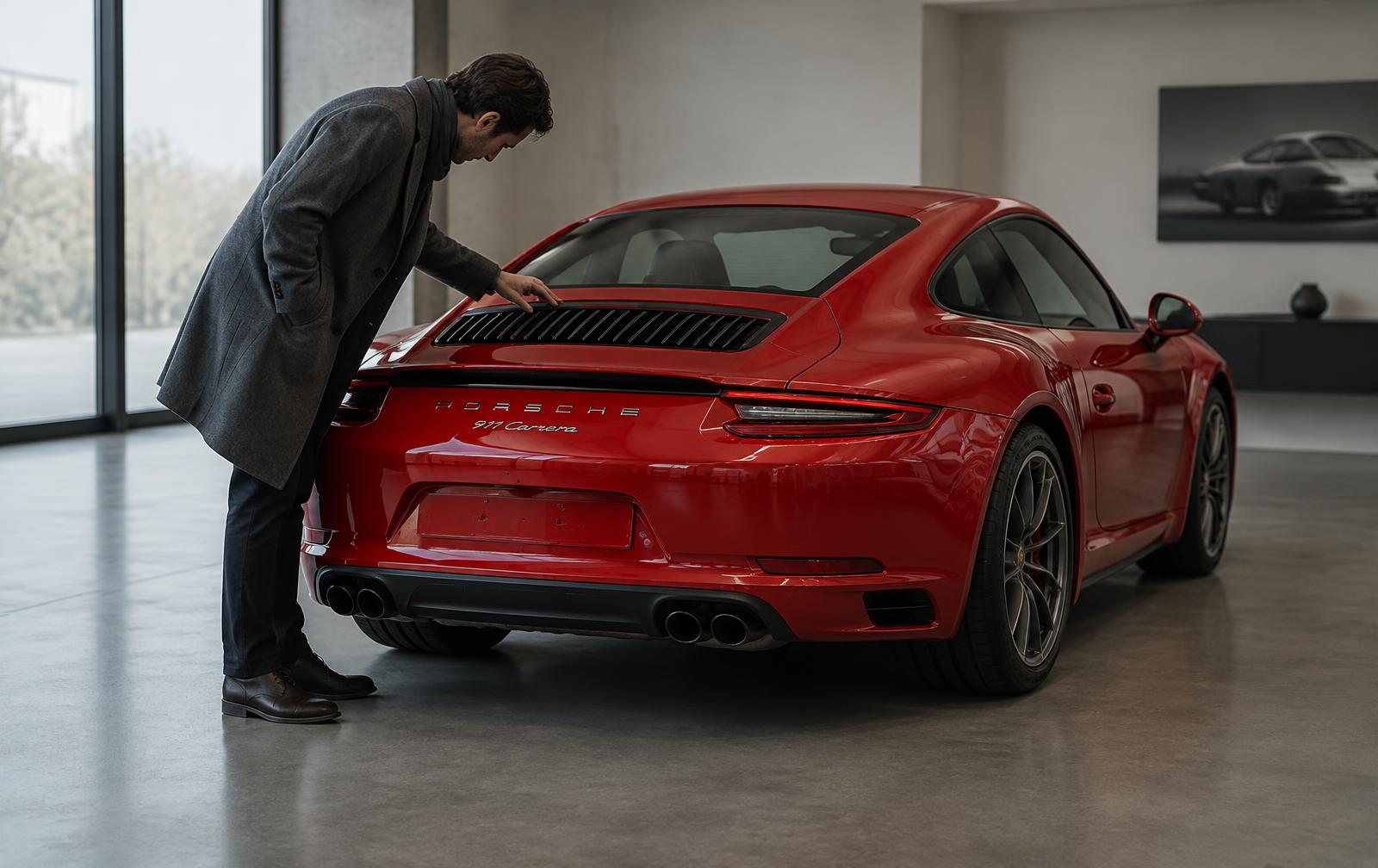
You've found the Porsche you've been looking for.
A beautifully presented 997 Carrera S, finished in the right colour, with an attractive specification, relatively low mileage and a collection of impressive photographs.
The bidding currently sits at £28,000. Comparable cars advertised by Porsche specialists are closer to £35,000.
You start doing the maths.
Why pay a dealer's margin when you could buy the same car directly from its owner through an online auction?
It seems like a straightforward opportunity to save several thousand pounds.
But are you actually comparing the same thing?
The growth of online automotive auction platforms has fundamentally changed how enthusiasts buy and sell specialist vehicles. Platforms such as Collecting Cars have made it easier to access interesting Porsches, unusual specifications and privately owned enthusiast vehicles.
There are undoubtedly good cars sold through these platforms. There are also knowledgeable buyers who understand precisely what they are purchasing and the risks they are accepting.
However, there is a considerable difference between buying a Porsche at an attractive hammer price and buying a properly inspected, mechanically prepared Porsche with a transparent history and meaningful consumer protection.
At 2911, we believe buyers should understand that difference before placing a bid.
Because when it comes to buying a used Porsche, the cheapest purchase price does not necessarily translate into the cheapest ownership experience.
Is it better to buy a Porsche at auction or from a specialist?
Buying a Porsche at auction can provide access to unusual specifications and potentially lower purchase prices, but buyers may face additional fees, limited mechanical inspection opportunities, uncertain maintenance requirements and significantly fewer consumer protections when purchasing from a private seller.
Buying from a reputable independent Porsche specialist typically provides greater visibility into mechanical condition, vehicle provenance, pre-sale preparation, warranty arrangements and statutory consumer rights.
The better option depends on the individual car, the seller's legal status, the buyer's mechanical knowledge and the total cost of bringing the vehicle to an equivalent standard.
| Buying consideration | Online auction | Reputable Porsche specialist |
|---|---|---|
| Advertised purchase price | Potentially lower hammer price | Typically includes a commercial margin |
| Buyer's fee | Often charged separately | Normally reflected in the advertised price |
| Mechanical inspection | Depends on seller cooperation | Greater opportunity for specialist assessment |
| Cylinder bore inspection | Not necessarily available | Can be arranged or documented where appropriate |
| Vehicle preparation | Varies considerably | Typically undertaken before retail sale |
| Test drive | Subject to seller agreement | Generally available by arrangement |
| Statutory consumer rights | Depend on seller status and auction format | Apply to qualifying trader-to-consumer sales |
| Warranty | Not necessarily included | Depends on the specialist's offering |
| Post-purchase support | Often limited | Established commercial relationship |
| Unexpected expenditure | Greater uncertainty without inspection | Potentially reduced through appropriate preparation |
Neither purchasing route guarantees a fault-free Porsche.
The important distinction is how much uncertainty you are accepting and whether the purchase price adequately compensates you for that uncertainty.
How do online Porsche auctions work in the UK?
Online auction platforms have made buying specialist vehicles significantly more accessible.
Rather than attending a traditional auction house, buyers can review photographs, vehicle descriptions, service documentation, videos and seller responses before bidding remotely.
The process generally follows several stages:
The seller submits the vehicle to the auction platform.
Photographs and a vehicle description are prepared.
The auction goes live for a defined bidding period.
Registered buyers submit bids.
The highest qualifying bidder enters into an agreement to purchase the vehicle.
The buyer pays the applicable auction fee.
Payment and vehicle collection are arranged according to the platform's terms.
Platforms such as Collecting Cars provide extensive photographic coverage and opportunities to ask the seller questions.
These are useful features. However, facilitating a vehicle sale is not the same as mechanically preparing a vehicle for retail ownership.
An auction platform and an independent Porsche specialist perform fundamentally different commercial functions.
One facilitates a transaction. The other, when operating as a responsible retail specialist, assumes additional responsibilities for vehicle selection, inspection, preparation and aftersales support.
Understanding that distinction is essential when comparing prices.
The hidden economics of buying a Porsche at auction
One of the most common misconceptions about buying a Porsche at auction is that removing the traditional dealer from the transaction removes the commercial margin.
In reality, the transaction has a different cost structure.
How much does Collecting Cars charge buyers in the UK?
According to Collecting Cars' published fee guidance, its standard seven-day live vehicle auctions carry a buyer's premium of 6% plus VAT, equivalent to 7.2% for UK buyers, subject to applicable minimum and maximum fees.
The winning bidder pays this premium in addition to the hammer price.
collectingcars.com
Here is what that means for a selection of Porsche purchase prices.
| Auction hammer price | Buyer's premium at 7.2% | Total acquisition price |
|---|---|---|
| £20,000 | £1,440 | £21,440 |
| £25,000 | £1,800 | £26,800 |
| £30,000 | £2,160 | £32,160 |
| £35,000 | £2,520 | £37,520 |
| £40,000 | £2,880 | £42,880 |
| £50,000 | £3,600 | £53,600 |
| £60,000 | £4,320 | £64,320 |
These calculations assume the standard percentage applies without a minimum or maximum fee adjustment.
Always check the platform's current terms and the specific auction conditions before bidding.
A Porsche advertised at £30,000 during an online auction is not necessarily a £30,000 purchasing proposition.
Even if you win at that price, your expenditure has already increased to £32,160 before arranging collection, inspection, servicing or any necessary remedial work.
The difference between a dealer margin and an auction fee
A buyer's premium pays for the auction platform's services.
A specialist dealer's margin contributes towards a broader commercial operation, which may include:
Vehicle sourcing and selection.
Mechanical and structural inspections.
Diagnostic investigation.
Servicing and remedial work.
Replacement parts and consumables.
History verification and documentation.
Stock holding and business overheads.
Warranty provision.
Aftersales support.
Responsibilities arising from consumer protection legislation.
Of course, not every specialist prepares its vehicles to the same standard.
Buyers should establish exactly what work has been completed rather than assume that a higher advertised price automatically represents a better car.
Nevertheless, comparing an auction hammer price directly against a specialist retail price overlooks potentially significant differences in what the buyer receives.
An auction fee facilitates the purchase. A reputable specialist's preparation should improve the ownership proposition.
The £3,000 to £5,000 recommissioning problem
An older Porsche can look outstanding in photographs while still requiring substantial mechanical expenditure.
The paintwork may be immaculate. The leather may be beautifully presented. The service book may contain an impressive collection of stamps.
But when was the brake fluid last changed?
How old are the tyres?
Are the suspension arms beginning to deteriorate?
Are the air-conditioning condensers corroded?
Is a major service approaching?
Has the engine been inspected for model-specific concerns?
These are the questions that determine how much money you may need to spend after collecting the car.
What does Porsche recommissioning mean?
Recommissioning is the process of addressing outstanding servicing, maintenance, deterioration and mechanical issues to bring a vehicle to an appropriate standard for continued ownership.
It is particularly relevant when purchasing older enthusiast vehicles that have covered limited mileage, received inconsistent maintenance or accumulated deferred repair requirements.
A £3,000 to £5,000 post-purchase budget is a plausible planning allowance for an older Porsche requiring several routine maintenance and remedial items.
It is not a statistically established average for auction purchases, and some cars will need considerably less work. Others, particularly those with significant engine or transmission problems, may require substantially more.
Illustrative Porsche 997 recommissioning costs
| Maintenance or repair item | Illustrative allowance |
|---|---|
| Major service and associated maintenance | £700 |
| Replacement tyres | £900 |
| Brake discs and pads | £1,100 |
| Suspension arms and geometry | £850 |
| Air-conditioning and cooling system attention | £600 |
| Additional minor remedial work | £350 |
| Total | £4,500 |
These are hypothetical budgeting figures, not a 2911 workshop quotation.
They are consistent with the principle demonstrated by published UK independent specialist maintenance schedules: routine servicing, brakes, clutch work and age-related repairs can individually represent significant expenditure.
Independent Porsche Specialists+2
Importantly, this example does not include an engine rebuild, replacement gearbox, major accident repair or other significant mechanical failure.
The £4,500 relates to ordinary maintenance and preparation items that can accumulate on an ageing sports car.
That is where a supposedly inexpensive auction purchase can begin to lose its financial advantage.
Auction Porsche vs specialist Porsche: A real-world cost comparison
Consider two hypothetical Porsche 997 Carrera S examples with comparable mileage, specification and cosmetic appearance.
One is available through an online auction. The other is offered by a reputable Porsche specialist following inspection and preparation.
| Purchase cost | Auction Porsche | Specialist Porsche |
|---|---|---|
| Hammer price or retail price | £30,000 | £35,995 |
| Auction buyer's premium | £2,160 | £0 |
| Collection and transport | £350 | £350 |
| Additional independent inspection | £500 | £500 |
| Immediate servicing and remedial work | £4,500 | £0 assumed |
| Total initial expenditure | £37,510 | £36,845 |
Despite initially appearing £5,995 cheaper, the auction Porsche ultimately costs £665 more under these assumptions.
The purchase price is not the total price
Illustrative Porsche 997 Carrera S acquisition comparison
Auction purchase
£37,510
£30,000 hammer price plus fees, inspection, transport and preparation.
Specialist purchase
£36,845
£35,995 prepared retail price plus transport and optional independent inspection.
Vehicle price
Auction premium
Inspection and transport
Recommissioning
Additional expenditure on the auction car
£665
Hypothetical comparison. Assumes the specialist car has already received equivalent preparation and requires no immediate remedial expenditure. Neither vehicle represents actual 2911 stock.
The auction buyer may also need to spend considerable time arranging inspections, obtaining repair quotations, booking workshop appointments and managing vehicle downtime.
None of that is reflected in the financial comparison.
Equally, an auction car requiring little or no remedial work could remain substantially cheaper.
That is precisely why establishing its mechanical condition before bidding matters so much.
Porsche auction true-cost calculator
Before placing a bid on Collecting Cars or another auction platform, use the following calculator to compare the total acquisition cost with an equivalent specialist-prepared Porsche.
Porsche auction vs specialist cost calculator
Calculate what your Porsche could actually cost once it is inspected, collected and prepared.
Auction purchase
Expected hammer price (£)
Buyer's fee including VAT (%)
Minimum auction fee (£)
Maximum auction fee (£)
Collection and transport (£)
Specialist inspection (£)
Enter applicable fee limits from the auction terms. Zero disables the relevant limit.
Expected post-purchase maintenance and repairs (£)
Specialist purchase
Specialist retail price (£)
Additional inspection, transport or maintenance (£)
Calculated auction buyer's premium
£2,160
Total auction acquisition cost
£37,510
Total specialist acquisition cost
£36,845
Auction purchase costs more by
£665
Maximum auction hammer price to match the specialist's total cost
£29,379
This is a cost-equivalent bidding ceiling, not a recommended bid or individual vehicle valuation. Allow additional financial headroom for unknown mechanical risks.
Copy purchase comparisonReset assumptionsCompare with 2911 Approved PorschesAll default vehicle prices and maintenance costs are illustrative. Auction terms vary. The model excludes the financial value of warranties, statutory rights, downtime and unexpected future mechanical failures.
The most useful figure is not necessarily the projected saving.
It is the maximum hammer price at which the auction car remains financially competitive after accounting for all known expenditure.
Establish that figure before bidding, not when the auction has two minutes remaining.
What are the risks of buying a Porsche at online auction?
The principal risks of buying a Porsche at online auction include limited pre-purchase mechanical inspection, undiscovered engine or structural problems, incomplete maintenance documentation, additional buyer's fees, unexpected recommissioning costs and reduced consumer protection when purchasing from a private seller.
These risks are particularly relevant to older Porsche 911 generations, where mechanical condition can influence the true cost of ownership far more significantly than mileage or cosmetic appearance.
An online auction can provide extensive information about a vehicle. However, there is a considerable difference between information supplied for marketing purposes and evidence obtained through a comprehensive mechanical inspection.
Why photographs cannot replace a Porsche specialist inspection
Online automotive auction listings frequently contain hundreds of high-resolution photographs.
You can examine the exterior paintwork, interior condition, wheels, service book, engine compartment and various areas of the vehicle.
That level of transparency is useful.
But there are certain things photographs simply cannot establish.
| Vehicle condition | What photographs may show | What requires specialist investigation |
|---|---|---|
| Paintwork | Visible scratches and cosmetic imperfections | Paint thickness, previous repairs and concealed damage |
| Engine | Visible condition and accessible components | Internal cylinder condition and mechanical integrity |
| Suspension | Apparent ride height and visible components | Bush deterioration, joint movement and damper condition |
| Brakes | Visible disc surfaces | Remaining service life, inner surfaces and braking performance |
| Cooling system | Accessible radiators and coolant reservoirs | Leaks, corrosion and pressure-related problems |
| Transmission | Gear selector and surrounding trim | Clutch wear, gear engagement and transmission behaviour |
| Underbody | Selected photographs | Structural condition, corrosion and concealed deterioration |
| Electrical systems | Dashboard appearance | Stored faults, diagnostic history and component functionality |
A beautifully photographed Porsche is not necessarily a mechanically excellent Porsche.
Professional automotive photography is designed to communicate a vehicle's appearance. It does not automatically establish its underlying condition.
What a cold-start video cannot tell you
Many auction listings include videos showing the engine being started from cold.
These can provide useful information.
An experienced Porsche technician may identify unusual noises, excessive smoke or obvious irregularities that deserve further investigation.
However, a cold-start video cannot conclusively rule out cylinder bore scoring, establish oil pressure under different operating conditions or reveal every mechanical fault.
Microphone placement, recording quality, ambient temperature and engine temperature can also influence what the viewer hears.
A video should form part of the available evidence, not replace an appropriate mechanical assessment.
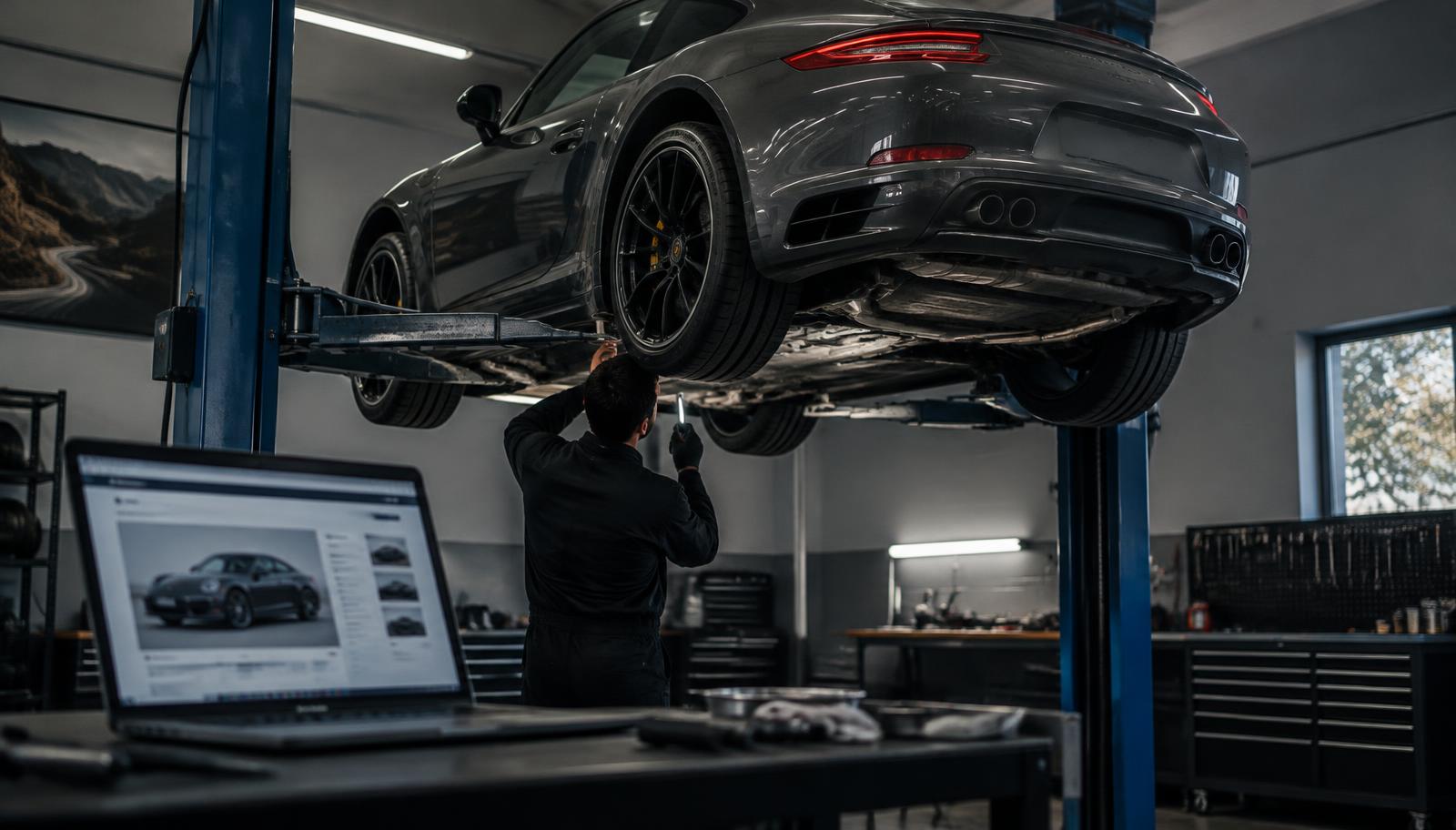
Why putting a Porsche on a ramp matters
Some of the most financially significant issues affecting an older Porsche are not visible when the vehicle is parked on a driveway.
Underbody inspection
Allows closer examination of structural areas, fluid leaks, corrosion and mechanical components.
Suspension assessment
Helps identify deterioration and wear that exterior photographs cannot establish.
A comprehensive ramp inspection can help a technician assess areas including:
Engine and transmission oil leaks.
Coolant leaks and deteriorated hoses.
Suspension arms, bushes and ball joints.
Shock absorber condition.
Brake pipes and flexible hoses.
Inner brake disc surfaces.
Exhaust corrosion and mounting points.
Structural repair evidence.
Underbody damage.
Steering components.
Driveshaft gaiters.
Corrosion in relevant structural and mounting areas.
These checks become increasingly important when purchasing a Porsche that is fifteen, twenty or thirty years old.
An MOT certificate is not a substitute for this level of inspection.
The MOT assesses specified roadworthiness and environmental requirements at the time of testing. It is not a comprehensive mechanical health assessment or prediction of future maintenance requirements.
A Porsche can have a valid MOT and still require thousands of pounds of preventative maintenance or mechanical work.
Can you arrange a ramp inspection before an online auction ends?
Sometimes, yes.
A cooperative seller may allow the vehicle to be taken to an independent Porsche specialist before the bidding deadline.
However, practical restrictions can include the seller's availability, vehicle location, auction duration, workshop availability and willingness to accommodate an inspection.
Some auctions conclude before the buyer has sufficient time to organise meaningful mechanical due diligence.
That does not automatically mean the seller is concealing a problem.
But it does mean the buyer is being asked to make a financial commitment with less information than they might otherwise obtain.
If an appropriate inspection cannot be completed, the potential financial exposure should influence the maximum amount you are prepared to bid.
Porsche bore scoring: The mechanical risk an auction listing cannot rule out
For buyers considering a Porsche 996 or first-generation 997 Carrera, cylinder bore scoring is one of the most important model-specific mechanical concerns to understand.
Bore scoring refers to damage affecting the internal cylinder surfaces of an engine.
Depending on its severity, it can contribute to increased oil consumption, abnormal engine noises, reduced performance and the requirement for significant engine repairs.
It is not a universal problem affecting every water-cooled Porsche.
However, certain M96 and M97 engine variants warrant particular attention.
Which Porsche models should receive particular attention?
| Porsche model | Relevant mechanical consideration |
|---|---|
| 996 Carrera 3.4 | M96 engine-related concerns, including cylinder issues |
| 996 Carrera 3.6 | Cylinder bore condition and IMS-related considerations |
| 997.1 Carrera 3.6 | Relevant M96 engine concerns |
| 997.1 Carrera S 3.8 | Particularly important to investigate cylinder bore condition |
| 997.2 Carrera | Revised 9A1 engine architecture with different risk characteristics |
| 996 and 997.1 Turbo | Different engine architecture from equivalent Carrera models |
| Relevant Boxster and Cayman models | Certain M96 and M97 engines may require similar assessment |
Mechanical risks vary according to the specific engine, production period, vehicle history and individual condition.
Buyers should avoid applying the same engine concerns indiscriminately across every Porsche model.
What does cylinder borescope inspection reveal?
Cylinder surface inspection
Technicians assess the condition of accessible internal cylinder surfaces.
Potential bore scoring
Visible scoring can warrant further specialist investigation and repair assessment.
A borescope allows a technician to examine internal engine areas that cannot be assessed through ordinary external inspection.
When investigating a susceptible Porsche engine, the inspection method, cylinder coverage, viewing angle and interpretation of the findings are important.
Different inspection approaches may provide different levels of visibility into the cylinder surfaces.
A meaningful report should explain what was inspected, what was observed and whether further investigation is recommended.
Even a favourable borescope inspection represents the condition observed at the time of assessment. It cannot guarantee that future deterioration will never occur.
What are the warning signs of Porsche bore scoring?
Potential indicators can include increased oil consumption, unusual ticking or knocking noises, exhaust soot differences and other symptoms consistent with cylinder deterioration.
However, these symptoms are not conclusive on their own.
Other mechanical conditions can produce similar characteristics, and early-stage cylinder damage may not present obvious symptoms.
That is why a statement such as "the engine sounds lovely" or "the car has never used much oil" should not be treated as definitive evidence of internal engine condition.
Established Porsche engine specialists such as Hartech provide specialist investigation and engine rebuilding services for relevant cylinder scoring and other engine-related problems.
How much could an undiscovered engine problem cost?
Consider a hypothetical auction purchase involving a Porsche 997.1 Carrera S.
| Financial component | Amount |
|---|---|
| Auction hammer price | £25,000 |
| Buyer's premium at 7.2% | £1,800 |
| Collection and initial inspection | £850 |
| Routine recommissioning | £3,500 |
| Illustrative engine rebuild expenditure | £14,000 |
| Total acquisition and remedial expenditure | £45,150 |
The £14,000 rebuild figure is an illustrative scenario rather than a current workshop quotation.
Actual costs depend on the engine, extent of damage, components required, engineering work and scope of the rebuild.
Nevertheless, the example demonstrates the significance of engine condition when evaluating the financial attractiveness of an auction Porsche.
A £25,000 winning bid can become a £45,000 ownership proposition remarkably quickly.
That is not an argument against buying a 997.1.
It is an argument for buying one with your eyes open.
Why a full service history is not always enough
One of the most reassuring phrases in a used Porsche advertisement is full service history.
But what does it actually mean?
A stamped service book establishes that certain services were recorded at particular dates and mileages.
It does not necessarily establish that every recommended repair was authorised, every advisory was addressed or every age-related component was replaced when appropriate.
Imagine two Porsche 911s with identical mileage and apparently complete service histories.
| Maintenance history | Porsche A | Porsche B |
|---|---|---|
| Stamped service book | Yes | Yes |
| Detailed historical invoices | Limited | Comprehensive |
| Suspension refurbishment | Unknown | Documented |
| Brake replacement | Unknown | Recently completed |
| Cooling system maintenance | Unknown | Documented |
| Relevant engine assessment | Not supplied | Documented |
| Outstanding workshop advisories | Unknown | Reviewed |
| Previous bodywork repairs | Unclear | Disclosed and documented |
Both cars could reasonably be advertised as having a full service history.
Yet their maintenance requirements and financial risk profiles could be very different.
The supporting documentation matters.
What should a Porsche history file contain?
A comprehensive vehicle history file should ideally contain, where available:
Original service documentation.
Detailed maintenance and repair invoices.
Historical MOT records.
Evidence of significant mechanical work.
Relevant engine inspection or rebuild documentation.
Ownership information.
Factory specification details.
Documentation relating to modifications.
Evidence of previous bodywork or accident repairs.
Recent inspection findings.
An incomplete history does not automatically mean a Porsche is unsuitable.
Older vehicles inevitably accumulate varying levels of documentation.
However, missing information creates uncertainty, and that uncertainty should be reflected in the purchasing decision.
At 2911, the history file is assembled before the car is advertised, rather than becoming something the buyer has to reconstruct after purchase.
You can learn more about this approach through the 2911 Approved process.
Buying a Porsche at auction: What are your consumer rights in the UK?
This is arguably the most important distinction between buying from an online auction and buying from a professional Porsche retailer.
However, it is also an area where considerable misinformation exists.
It is incorrect to assume that every auction purchase carries no statutory consumer protection.
The legal position depends on who is selling the vehicle, how the sale is conducted and the nature of the contract.
Buying from a private seller through an online auction
When you buy a Porsche from a genuine private individual, you generally do not receive the same statutory protections that apply when buying from a motor trader.
The Consumer Rights Act 2015 does not ordinarily impose its trader-to-consumer requirements on a genuine private vehicle sale.
This means that discovering a mechanical fault after purchasing the car does not automatically give you the right to demand a repair, replacement or refund.
However, private purchases are not completely without legal protection.
The seller must generally have the legal right to sell the vehicle, and the vehicle must correspond with its contractual description. Misrepresentation and other legal issues may also create potential remedies, depending on the circumstances.
The practical difficulty is establishing the nature of the problem, what the seller represented, and which legal remedies are available.
Buying from a motor trader through an online auction
Some vehicles advertised through online auction platforms are sold by motor traders rather than private individuals.
Collecting Cars, for example, identifies trade sellers on its platform.
Where a trader sells to a consumer through an online-only auction, applicable consumer protections generally remain relevant.
The fact that the transaction takes place through an auction website does not automatically remove the seller's statutory responsibilities.
Different rules can apply to qualifying public auctions where buyers have the opportunity to attend in person.
Buyers should therefore establish the seller's legal status and the specific transaction arrangements before bidding.
Buying from a Porsche specialist
When purchasing a used Porsche from a motor trader as a consumer, the Consumer Rights Act 2015 generally requires the vehicle to be of satisfactory quality, fit for an agreed purpose and accurately described.
The assessment of satisfactory quality takes account of relevant factors, including the vehicle's age, mileage, price, description and other circumstances.
A twenty-year-old Porsche is not expected to be in the same condition as a brand-new vehicle.
Nevertheless, its age does not automatically remove the retailer's legal responsibilities.
Consumer protection comparison
| Consumer protection | Genuine private auction sale | Online-only trader sale | Specialist retail purchase |
|---|---|---|---|
| Seller must have the right to sell | Yes | Yes | Yes |
| Vehicle must match contractual description | Generally yes | Yes | Yes |
| Consumer Rights Act satisfactory quality requirements | Generally no | Generally yes | Yes |
| Statutory short-term right to reject qualifying faulty goods | Generally no | Generally applicable | Applicable |
| Statutory repair or replacement remedies | Generally no | Subject to applicable requirements | Subject to applicable requirements |
| Six-month presumption concerning certain faults | Generally no | Generally applicable | Applicable |
| Additional commercial warranty | Not normally included | Depends on seller | Depends on retailer |
| Distance-selling cancellation rights | Generally no | May apply | May apply to qualifying distance sales |
The above is a general summary. Individual circumstances and legal exceptions can affect the rights available.
Sources: Consumer Rights Act 2015 and Business Companion guidance on distance sales.
legislation.gov.uk+2
What happens if your Porsche develops a fault after purchase?
Imagine collecting a Porsche 997 on Saturday afternoon.
Two weeks later, an unusual engine noise develops. A specialist inspection identifies significant mechanical damage that may have been present when the vehicle was sold.
The potential financial outcome can differ considerably depending on how you purchased the car.
If you bought from a genuine private seller
You may need to establish whether the vehicle was misdescribed, whether a relevant contractual obligation was breached or whether another legal basis for a claim exists.
The existence of an expensive mechanical fault alone does not necessarily establish that the seller is legally responsible.
You could find yourself arranging technical investigations, obtaining independent reports and pursuing a dispute without the same statutory framework available to a consumer purchasing from a motor trader.
If you bought from a specialist retailer
Under the Consumer Rights Act 2015, consumers may have a short-term right to reject goods that do not conform to the contract within the first 30 days, subject to the applicable conditions.
After that initial period, repair or replacement remedies generally become relevant before certain further remedies can be exercised.
For qualifying faults identified within the first six months, the law generally presumes that the underlying non-conformity existed at delivery unless the trader establishes otherwise or the presumption is incompatible with the circumstances.
Motor vehicles also have specific provisions relating to potential deductions for use when certain refund remedies apply.
These rights are not a blanket guarantee against every mechanical failure or normal wear item.
However, they provide a materially different legal framework from a genuine private purchase.
For someone buying a mechanically complex, ageing performance car, that difference deserves serious consideration.
What is the difference between a warranty and statutory consumer rights?
A commercial vehicle warranty and statutory consumer rights are two separate forms of protection.
A warranty generally provides contractual cover for specified components, faults or repair requirements for a defined period, subject to its terms and exclusions.
Statutory consumer rights arise through legislation and cannot ordinarily be removed simply by offering a limited warranty.
| Protection | Commercial vehicle warranty | Statutory consumer rights |
|---|---|---|
| Source | Warranty agreement | Applicable legislation |
| Duration | Defined by warranty terms | Depends on legal requirements and circumstances |
| Coverage | Specified components and eligible failures | Whether the goods conform to the contract |
| Exclusions | Defined by the policy | Governed by applicable law |
| Responsible party | Warranty provider or retailer, depending on arrangement | Relevant contracting trader |
| Can replace statutory rights? | No | Not applicable |
An expired three-month warranty does not automatically mean a consumer has lost every statutory right.
Similarly, purchasing an aftermarket warranty following an auction acquisition does not retrospectively create the statutory rights associated with a trader-to-consumer sale.
Buyers should review warranty coverage, exclusions, claim limits, labour allowances and eligibility requirements before relying on it.
Why an aftermarket warranty may not solve the auction risk
Some buyers assume that they can purchase a Porsche privately, arrange a separate warranty and achieve approximately the same level of protection as buying from a specialist.
That assumption deserves careful examination.
Depending on the warranty provider and policy, cover may exclude:
Pre-existing mechanical conditions.
Normal wear and deterioration.
Specific engine or transmission components.
Faults identified during eligibility inspections.
Vehicles exceeding relevant age or mileage limits.
Failures associated with inadequate maintenance.
Certain modified components.
Repair costs exceeding individual or aggregate claim limits.
Some warranties may also require an appropriate inspection before cover begins.
Porsche's own Approved Warranty has separate eligibility, inspection and contractual requirements.
Buying a private Porsche and arranging subsequent warranty cover can be a viable ownership strategy in appropriate circumstances.
But the buyer must establish whether the particular vehicle is eligible, what the warranty covers and what financial exposure remains.
For more information, read our guide to 2911 Approved vs Porsche Approved: What's the Real Difference?.
Seven psychological traps that can make auction buyers overpay
Online auctions are designed around competition, deadlines and immediate purchasing decisions.
Those characteristics make auctions engaging.
They can also make it more difficult to maintain financial discipline.
1. Anchoring to the opening bid
A Porsche advertised with bidding starting at £10,000 can create the impression that the eventual purchase will represent exceptional value.
The opening bid has little relevance to the vehicle's actual market value, mechanical condition or likely final sale price.
Establish an independent valuation before allowing the bidding history to influence your expectations.
2. Comparing the current bid with the highest dealer asking price
A buyer may compare a £30,000 auction bid with a £40,000 specialist advertisement and conclude that a £10,000 saving is available.
But the cars may differ significantly in condition, specification, provenance and preparation.
The appropriate comparison is between equivalent vehicles after accounting for all associated expenditure.
3. Fear of missing out
As an auction approaches its conclusion, buyers may begin to feel that they are losing a unique purchasing opportunity.
Perhaps the car has a particularly desirable colour or a rare interior combination.
That emotional pressure can encourage buyers to overlook unresolved questions.
Desirable Porsches can be difficult to find, but purchasing the wrong example can be considerably more frustrating than waiting for another opportunity.
4. Competitive bidding
Once another enthusiast starts bidding against you, the purchasing decision can gradually become a competition.
The objective shifts from acquiring the Porsche at an appropriate price to winning the auction.
Winning is not the same as buying well.
The highest bidder may simply be the person prepared to accept the greatest financial exposure.
5. Incremental price escalation
Another £500 may not appear particularly significant during a £30,000 purchase.
Neither does the next £500.
But several incremental decisions can move the hammer price thousands of pounds beyond the original budget.
Each additional bid may also increase the buyer's premium.
Calculate your maximum total expenditure before the auction approaches its conclusion.
6. Confirmation bias
Once a buyer becomes emotionally attached to a particular Porsche, they may focus on information that reinforces the purchasing decision.
A favourable comment from the seller receives greater attention than an unanswered mechanical question.
Attractive photographs outweigh incomplete documentation.
A successful MOT is interpreted as evidence that significant mechanical issues are unlikely.
Good Porsche buying requires investigating the information that could challenge your decision, not simply collecting reasons to justify it.
7. Treating an auction deadline as an inspection deadline
An auction ending on Sunday evening does not make an unresolved mechanical concern less important.
If sufficient information cannot be obtained before bidding closes, the buyer should be prepared to walk away.
The wrong Porsche purchased under pressure rarely becomes the right Porsche after collection.
How to buy a Porsche safely on Collecting Cars
There are knowledgeable enthusiasts who regularly make successful auction purchases.
The objective is not to suggest that every Porsche sold through an online platform represents a poor purchasing proposition.
It is to ensure buyers understand what meaningful due diligence involves.
Step 1: Identify the exact Porsche model and engine
Establish the model year, generation, engine variant, gearbox, drivetrain and factory specification.
Do not rely exclusively on a generic description such as 997 Carrera S.
Mechanical requirements and ownership considerations can differ between production periods and derivatives.
Step 2: Establish the seller's legal status
Confirm whether you are buying from a private individual, a motor trader or through another contractual arrangement.
Review the platform's terms to understand who you are entering into a vehicle purchase contract with.
Step 3: Review the complete maintenance history
Examine available invoices rather than relying exclusively on the number of service stamps.
Identify significant work already undertaken and maintenance items approaching their replacement intervals.
Step 4: Investigate the vehicle's ownership and finance history
Undertake appropriate vehicle history checks covering outstanding finance, recorded accident damage, theft records and mileage discrepancies.
Review the vehicle identification number and relevant documentation.
Remember that a clear vehicle history check does not establish that the car has never experienced unrecorded damage.
Step 5: Arrange a specialist pre-purchase inspection
Where practical, arrange an independent Porsche inspection before committing to the purchase.
The scope should reflect the specific vehicle and its known mechanical considerations.
For relevant 996 and 997.1 Carrera models, discuss whether an appropriate cylinder borescope inspection should form part of the assessment.
Step 6: Obtain realistic repair and maintenance estimates
If the inspection identifies suspension wear, ageing tyres, brake deterioration or other maintenance requirements, obtain realistic estimates before bidding.
Do not assume that every item can be addressed inexpensively.
Step 7: Calculate your maximum hammer price
Start with the total amount you are comfortable spending to acquire the car in an appropriate condition.
Deduct estimated transport, inspection, auction fees, immediate maintenance and any financial allowance you require for unresolved risk.
The remaining amount determines your bidding ceiling.
Step 8: Review the contractual commitment
Auction bids may be legally binding.
Collecting Cars, for example, explains that the successful bidder enters into an agreement to purchase the vehicle, with the buyer's premium subsequently charged and collection arranged with the seller.
Do not assume you can win an auction and then undertake a mechanical inspection as a condition of completing the purchase unless that arrangement has been expressly agreed in advance.
Step 9: Verify payment and collection arrangements
Confirm the seller's identity and payment instructions using appropriate verification procedures.
Be particularly cautious if banking instructions change unexpectedly.
Arrange suitable insurance, transport and collection arrangements before taking possession.
Step 10: Be prepared not to buy
The ability to walk away is one of the most valuable tools available to a Porsche buyer.
If the purchase price no longer compensates for the uncertainty, another vehicle may represent a better proposition.
Questions to ask before bidding on a Porsche
A seller's willingness to provide clear, specific answers can reveal considerably more than a polished vehicle description.
| Question | What the answer helps establish |
|---|---|
| When was the most recent major service? | Immediate servicing requirements |
| Are detailed maintenance invoices available? | Mechanical provenance |
| Has the engine received significant repairs? | Engine history and potential risk |
| Has a cylinder borescope inspection been performed where relevant? | Evidence of internal cylinder condition |
| Is the engine using oil, and if so, how much? | Potential mechanical investigation requirements |
| Has the clutch been replaced? | Possible transmission-related expenditure |
| When were the suspension components last reviewed or replaced? | Ride quality and maintenance exposure |
| What are the age and condition of the tyres? | Immediate replacement requirements |
| Are there outstanding workshop advisories? | Deferred maintenance |
| Has the vehicle received previous paintwork or accident repairs? | Bodywork history and originality |
| Are there any warning lights or stored diagnostic faults? | Potential electrical or mechanical concerns |
| Can an independent Porsche specialist inspect the vehicle before bidding closes? | Opportunity to reduce purchasing uncertainty |
Where an answer is unclear, ask for supporting documentation.
There is a considerable difference between a seller stating that something has been completed and supplying the corresponding invoice or inspection report.
Interactive Porsche auction purchasing checklist
Before committing to a bid, use this checklist to assess how much information you actually have about the vehicle.
Porsche auction purchase readiness
0/14
The exact model, engine and factory specification have been verified.
The seller's identity and private or trade status are established.
Vehicle history, outstanding finance and legal ownership have been checked.
The available service book and maintenance invoices have been reviewed.
An appropriate independent mechanical inspection has been completed.
Relevant engine concerns, including bore scoring where applicable, have been investigated.
The vehicle's underside and structural condition have been appropriately assessed.
Previous accident damage, paintwork and significant repairs are understood.
Upcoming servicing and maintenance costs have been estimated.
Auction fees, VAT and transport costs are included in the budget.
The maximum total expenditure and bidding ceiling have been established.
Applicable consumer rights and warranty arrangements are understood.
Payment, insurance and collection arrangements are established.
A separate reserve exists for unexpected mechanical expenditure.
8 essential purchasing considerations remain unresolved.
There is still material uncertainty surrounding the proposed purchase. Obtain further information before making a binding financial commitment.
Copy purchasing checklistReset checklistCompletion of this checklist does not certify a vehicle's condition, legal status or suitability for purchase.
What should a Porsche specialist do before selling you a car?
Not every independent Porsche dealership operates to the same standard.
Buying from a specialist should involve more than purchasing a privately sourced vehicle, having it professionally valeted and advertising it at a higher price.
The additional value should be visible in the vehicle's condition, preparation and supporting documentation.
A credible Porsche specialist should be able to explain:
| Specialist responsibility | What the buyer should expect |
|---|---|
| Vehicle selection | A clear rationale for purchasing and retailing the individual car |
| Provenance | Review of ownership, maintenance and relevant vehicle history |
| Mechanical inspection | Appropriate assessment by knowledgeable technicians |
| Diagnostic assessment | Investigation of relevant faults and vehicle-specific concerns |
| Remedial work | Evidence of preparation undertaken before sale |
| Cosmetic condition | Transparent assessment of age-related wear and previous repairs |
| Documentation | Accessible history file and preparation records |
| Warranty | Clear explanation of coverage, limitations and duration |
| Handover | Opportunity to understand the car and its maintenance requirements |
| Aftersales | An accountable commercial relationship following the purchase |
The important distinction is between a dealer claiming that a vehicle has been inspected and a dealer being able to demonstrate what the inspection involved and what happened as a result.
The 2911 Approved process: What are you actually paying for?
At 2911, every Porsche offered for retail sale goes through our independent specialist approval process.
The process is built around five stages: curation, inspection, preparation, documentation and handover.
Each stage addresses a different source of purchasing uncertainty.
Five steps. One standard.
01
Curation
Select individual cars based on ownership patterns, maintenance records, provenance and suitability.
02
2911 Approved inspection
Assess mechanical, electrical, cosmetic and structural condition, with documented findings.
03
Preparation
Address identified requirements using genuine or specification-matched parts, with transparent disclosure of retained fair wear or historical marks.
04
The history file
Assemble available service records, MOT history and maintenance invoices before the vehicle is advertised.
05
Warranty and handover
Provide a personal vehicle and documentation walkthrough, explain warranty arrangements and complete an individual handover.
Explore the 2911 Approved process
Stage 1: Curation begins before the car becomes stock
The most important purchasing decision a specialist makes can happen before a prospective retail buyer ever sees the vehicle.
A Porsche with an inconsistent ownership history, questionable mechanical provenance or significant unexplained maintenance gaps may not be an appropriate retail proposition.
Selecting the right car in the first place is an important part of reducing subsequent ownership risk.
Stage 2: Inspection establishes the condition
The 2911 Approved process includes mechanical, electrical, cosmetic and structural assessment.
The objective is to understand the individual vehicle rather than rely on general assumptions about its model or generation.
Additional investigation requirements depend on the car's engine, age, condition and inspection findings.
Stage 3: Preparation addresses identified requirements
Inspection alone does not improve a vehicle's condition.
The work undertaken as a result of that inspection matters.
Our published process sets out the use of genuine or specification-matched parts for preparation, with transparent disclosure where fair wear or historical cosmetic marks are intentionally retained.
That distinction is important when buying an older enthusiast vehicle.
An excellent twenty-year-old Porsche does not necessarily need to be cosmetically indistinguishable from a new car.
It does need to be represented accurately.
Stage 4: The file establishes transparency
The available service documentation, historical invoices and MOT information are assembled before the vehicle is advertised.
A buyer should be able to understand the history of the Porsche without relying solely on the seller's verbal reassurance.
Stage 5: Warranty and personal handover establish accountability
2911's published process includes a three-month warranty provision as standard, alongside a personal video walkthrough and handover.
The precise warranty terms should be reviewed for the individual vehicle.
This provision is separate from the statutory consumer rights applicable to qualifying retail purchases.
The objective is not to suggest that an ageing Porsche will never develop a fault.
No responsible specialist can promise that.
The objective is to give buyers a clearer understanding of the car, the preparation completed and the relationship they have with the specialist following the purchase.
Read the complete 2911 Approved process or explore our current Porsche collection.
When does buying a Porsche at auction make sense?
There are circumstances where purchasing a Porsche through an auction can be entirely appropriate.
You have significant mechanical knowledge
An experienced Porsche owner may understand the relevant mechanical risks, recognise problematic maintenance histories and have established relationships with trusted specialists.
That knowledge can make it easier to evaluate uncertain purchasing opportunities.
You are looking for an unusual factory specification
A particularly rare colour, interior combination or limited-production derivative may become available through auction when comparable cars are difficult to find through traditional retail channels.
The acquisition opportunity may justify additional investigation.
You are deliberately purchasing a project
Some enthusiasts actively seek cars requiring engine work, suspension refurbishment or cosmetic restoration.
They may have a clear understanding of the required expenditure and prefer to control the restoration process themselves.
In those circumstances, purchasing an unprepared Porsche can be part of the intended ownership experience.
You can arrange a comprehensive pre-purchase inspection
If the seller accommodates an appropriate specialist inspection and supplies comprehensive supporting documentation, much of the purchasing uncertainty may be reduced.
The buyer must still understand the contractual arrangements and applicable consumer protections.
The purchase price genuinely compensates for the risk
An auction purchase may make financial sense when the total acquisition price remains materially attractive after accounting for fees, known maintenance and unresolved mechanical uncertainty.
For example, consider the following hypothetical comparison.
| Cost component | Auction Porsche | Specialist Porsche |
|---|---|---|
| Vehicle price | £24,000 | £32,000 |
| Buyer's premium | £1,728 | £0 |
| Transport and inspection | £850 | £850 |
| Immediate maintenance | £1,200 | £0 assumed |
| Total initial expenditure | £27,778 | £32,850 |
In this scenario, the auction purchase remains £5,072 cheaper.
If the vehicle has been appropriately inspected and the buyer is comfortable with the remaining uncertainty, that saving could be commercially meaningful.
The important consideration is whether the financial comparison reflects the car's actual condition.
A specialist purchase is not automatically better value in every situation.
Equally, an auction purchase is not automatically a bargain because its hammer price is lower.
When is buying from a Porsche specialist the better option?
A specialist purchase may be particularly appropriate when:
You are purchasing your first Porsche.
You have limited experience assessing older performance vehicles.
You do not have an established Porsche technician.
You want a mechanically prepared vehicle rather than a restoration project.
You have limited time to organise inspections and remedial work.
You are considering a model with significant condition-sensitive mechanical risks.
You value transparent documentation and personal guidance.
You want applicable statutory consumer protections.
You prefer an accountable relationship following the purchase.
You want to understand your likely near-term ownership expenditure.
Many enthusiasts are capable of assessing whether they like a Porsche.
Far fewer are equipped to assess the condition of its internal engine components, structural history, ageing suspension and accumulated maintenance requirements.
There is nothing unreasonable about paying for expertise that reduces those uncertainties.
The key is establishing that the specialist genuinely provides that expertise.
Is an auction Porsche a better investment?
A lower initial purchase price can support stronger long-term ownership economics, provided that the vehicle does not require disproportionately greater expenditure.
However, an auction purchase can also become financially less attractive when the initial saving is absorbed by auction fees, servicing, repairs and historical remediation.
Consider two hypothetical ownership scenarios over three years.
| Financial component | Auction Porsche | Specialist Porsche |
|---|---|---|
| Initial vehicle price | £30,000 | £35,995 |
| Buyer's premium | £2,160 | £0 |
| Transport and inspection | £850 | £850 |
| Immediate remedial expenditure | £4,500 | £0 assumed |
| Subsequent maintenance | £4,500 | £4,500 |
| Total modeled expenditure | £42,010 | £41,345 |
| Eventual sale price | £32,000 | £32,000 |
| Illustrative net ownership cost | £10,010 | £9,345 |
The comparison assumes both vehicles reach equivalent condition and achieve the same eventual resale value.
It excludes insurance, vehicle tax, fuel, financing and selling expenses, which may also influence the overall financial outcome.
It demonstrates why the initial purchase price is only one part of the ownership equation.
A Porsche with comprehensive documentation and properly completed maintenance may also be easier to assess and market when you eventually decide to sell.
For buyers considering longer-term value retention, our guide to buying a Porsche 911 in the UK provides further context on purchasing routes and vehicle assessment.
The questions you should ask a Porsche specialist before buying
The same financial discipline applied to auction purchases should also be applied to specialist retail purchases.
Do not assume every independent dealer operates according to the same principles.
Ask the specialist the following questions.
| Question | What a credible answer should establish |
|---|---|
| Why did you choose to purchase this particular Porsche? | Understanding of the individual vehicle and its desirability |
| What inspection was undertaken before advertising it? | Clear mechanical assessment scope |
| What work was completed following the inspection? | Evidence of meaningful preparation |
| Were any inspection findings left unresolved? | Transparency concerning remaining issues |
| Has the engine been appropriately assessed? | Awareness of model-specific mechanical considerations |
| Can I review the complete available history file? | Accessibility of supporting documentation |
| Has the car received previous paintwork or accident repairs? | Honest disclosure of known vehicle history |
| What maintenance is likely to be required over the next twelve months? | Realistic ownership budgeting |
| What does the warranty cover? | Defined protection and exclusions |
| What happens if the car develops a problem after collection? | Clear aftersales responsibilities |
A good specialist should welcome informed questions.
You are not purchasing an ordinary consumer product.
You are purchasing a sophisticated piece of engineering that may have accumulated decades of use, maintenance, ownership changes and mechanical history.
The more you understand about that history, the more confidently you can approach ownership.
Frequently asked questions about buying a Porsche at auction
Is buying a Porsche at auction cheaper than buying from a dealer?
The hammer price may be lower, but the total acquisition cost can become comparable to or greater than a specialist retail purchase once buyer's fees, transport, inspections, servicing and mechanical repairs are included.
What are the risks of buying a Porsche at online auction?
The main risks include limited mechanical inspection, undiscovered engine problems, deferred maintenance, incomplete documentation, additional transaction fees and reduced consumer protection when buying from a genuine private seller.
How much are Collecting Cars buyer fees in the UK?
The platform's published standard seven-day live vehicle auction fee is 6% plus VAT, equivalent to 7.2% for UK buyers, subject to applicable minimum and maximum fees. Buyers should check current auction terms before bidding.
Does the Consumer Rights Act apply to cars purchased at auction?
It depends on the seller and auction format. Genuine private sales generally do not carry the same Consumer Rights Act protections as trader-to-consumer purchases. Online-only auctions involving trader sales can still attract applicable statutory consumer protections.
Can I return a faulty Porsche purchased at auction?
Your rights depend on the seller's status, contractual arrangements, auction format and nature of the fault. A genuine private purchase does not ordinarily provide the same statutory right to reject faulty goods as a qualifying purchase from a motor trader.
Can you have a Porsche inspected before an online auction ends?
Yes, if the seller cooperates and sufficient time is available. Arrange the inspection before placing a binding bid rather than assuming the purchase can be made conditional upon an inspection afterwards.
Should I have a Porsche 997 bore scoped before buying?
An appropriate cylinder borescope inspection can be particularly valuable when purchasing certain 997.1 Carrera models, especially the 3.8-litre Carrera S. The requirement should be assessed according to the specific engine and vehicle history.
Can a Porsche have bore scoring without obvious symptoms?
Yes. Cylinder deterioration may not always produce obvious symptoms during its earlier stages. An apparently smooth-running engine or favourable cold-start video cannot conclusively establish internal cylinder condition.
Is a full service history enough when buying a Porsche?
No. A consistent service history is valuable, but detailed invoices, recent inspections, documented mechanical work and evidence of outstanding maintenance provide a more complete understanding of the vehicle.
How much should I budget for recommissioning an auction Porsche?
A planning allowance of £3,000 to £5,000 may be appropriate for an older Porsche requiring several maintenance and remedial items. Actual costs can be significantly lower or higher, particularly where major engine or transmission work is required.
Does a valid MOT mean a Porsche is mechanically sound?
No. An MOT assesses specified roadworthiness and environmental requirements at the time of testing. It does not constitute a comprehensive mechanical inspection or guarantee that significant maintenance will not be required.
Can I buy an aftermarket warranty for a Porsche purchased privately?
Potentially, depending on the vehicle's age, mileage, condition and the warranty provider's eligibility requirements. Pre-existing conditions, wear-related faults and certain components may be excluded.
Are all Porsches sold through Collecting Cars private sales?
No. Trade sellers also use the platform. Establish the seller's legal status and review the applicable purchase terms before bidding.
Is 2911 Approved the same as Porsche Approved?
No. Porsche Approved is the manufacturer's own approved vehicle and warranty programme. 2911 Approved is an independent specialist vehicle selection, inspection, preparation and documentation process operated by 2911.
Should I avoid every Porsche sold at auction?
No. Excellent Porsches are sold through auctions, and informed buyers can find attractive opportunities. The important considerations are vehicle condition, appropriate due diligence, realistic total acquisition costs and the protections available.
What is the safest way to buy a used Porsche 911?
A well-considered purchase involves selecting the appropriate model, reviewing mechanical provenance, conducting relevant inspections, establishing realistic ownership costs and understanding the contractual protections. A reputable Porsche specialist can help coordinate these requirements, although no purchase is entirely without risk.
The 2911 perspective: Buy the car, not the winning bid
Online auctions have created an exciting marketplace for Porsche enthusiasts.
They provide access to interesting cars, unusual specifications and purchasing opportunities that might otherwise be difficult to find.
There is a legitimate place for them within the wider Porsche market.
But the excitement of winning an auction should never overshadow the realities of owning the car afterwards.
A £30,000 Porsche requiring £7,000 of additional expenditure is not a £30,000 Porsche.
A full service book without supporting mechanical evidence does not answer every important question.
A collection of beautiful photographs cannot establish internal engine condition.
And an attractive hammer price cannot replace the financial value of appropriate preparation, transparency and accountability.
Through 2911 and our sister business, The Porsche Buyer, we operate across different areas of the Porsche market, with vehicle selection, condition and provenance at the centre of our approach.
We understand that enthusiasts want to purchase their Porsches at sensible prices.
We also understand that the enjoyment of owning one can be diminished considerably when the first few months are spent arranging unexpected repairs.
That is why the 2911 Approved process begins before a vehicle is offered for sale.
The intention is to establish what the car is, understand its history, identify relevant preparation requirements and give the next owner a clear picture of what they are purchasing.
You should be able to collect your Porsche and concentrate on the reason you bought it in the first place.
To drive it.
To enjoy it.
To experience the qualities that make Porsche ownership so special.
The real measure of a Porsche bargain is not what you paid when the auction ended. It is what you ultimately spent to own the car you thought you were buying.
Explore our current collection of 2911 Approved Porsches, discover our five-stage approval and preparation process, or speak directly with Karl Meyer about finding the right Porsche for your ownership requirements.
Call Karl: 07779 100069
Email: sales@2911.co.uk
Auction fees, platform procedures and consumer protection guidance reflect information available in November 2026. All vehicle prices, maintenance allowances, repair costs and financial comparisons are illustrative rather than actual 2911 customer outcomes or workshop quotations. Inspection and warranty coverage vary according to the individual vehicle and applicable terms. Consumer rights depend on the seller's legal status, transaction format and individual circumstances. This article provides general information and does not constitute individual legal advice.
Quick answers
Is buying a Porsche at auction cheaper than buying from a dealer?
The hammer price may be lower, but the total acquisition cost can become comparable to or greater than a specialist retail purchase once buyer's fees, transport, inspections, servicing and mechanical repairs are included.
What are the risks of buying a Porsche at online auction?
The main risks include limited mechanical inspection, undiscovered engine problems, deferred maintenance, incomplete documentation, additional transaction fees and reduced consumer protection when buying from a genuine private seller.
How much are Collecting Cars buyer fees in the UK?
The platform's published standard seven-day live vehicle auction fee is 6% plus VAT, equivalent to 7.2% for UK buyers, subject to applicable minimum and maximum fees. Buyers should check current auction terms before bidding.
Does the Consumer Rights Act apply to cars purchased at auction?
It depends on the seller and auction format. Genuine private sales generally do not carry the same Consumer Rights Act protections as trader-to-consumer purchases. Online-only auctions involving trader sales can still attract applicable statutory consumer protections.
Can I return a faulty Porsche purchased at auction?
Your rights depend on the seller's status, contractual arrangements, auction format and nature of the fault. A genuine private purchase does not ordinarily provide the same statutory right to reject faulty goods as a qualifying purchase from a motor trader.
Can you have a Porsche inspected before an online auction ends?
Yes, if the seller cooperates and sufficient time is available. Arrange the inspection before placing a binding bid rather than assuming the purchase can be made conditional upon an inspection afterwards.
Should I have a Porsche 997 bore scoped before buying?
An appropriate cylinder borescope inspection can be particularly valuable when purchasing certain 997.1 Carrera models, especially the 3.8-litre Carrera S. The requirement should be assessed according to the specific engine and vehicle history.
Can a Porsche have bore scoring without obvious symptoms?
Yes. Cylinder deterioration may not always produce obvious symptoms during its earlier stages. An apparently smooth-running engine or favourable cold-start video cannot conclusively establish internal cylinder condition.